
Go Flourish
Connecting Children’s Education, Communities, and Nature Through School Gardens
Garden Openers J.J. Gladwin of Old Allangrange tell us about the importance of engaging children in gardening and huge impact it can have - and what she is doing to make that a reality.
Why start a charity?
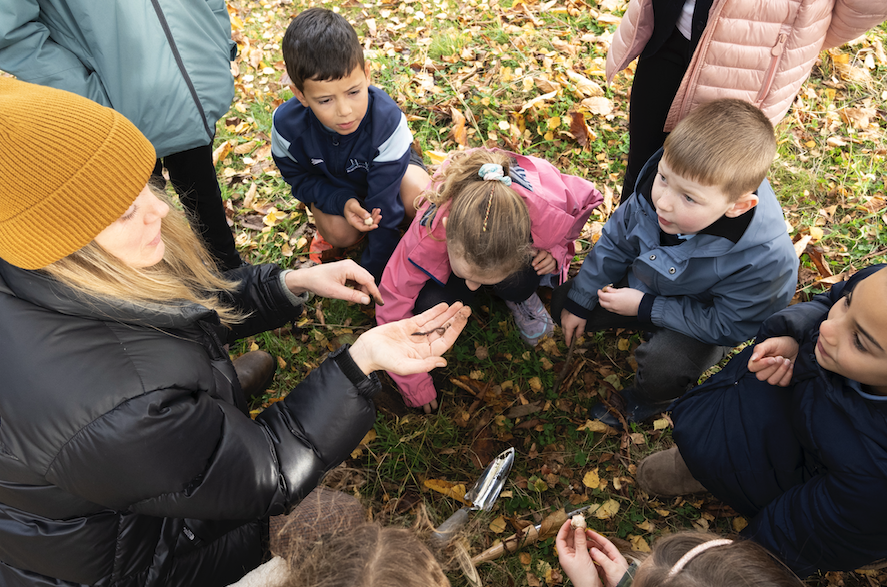
We started to host school children at home nine years ago because I am a gardener, we have a garden, and we thought it was a good thing to do. We have opened our garden through Scotland’s Gardens Scheme for a good number of years, so it was obvious to choose our garden-based charity as our SGS beneficiary.
We learnt that simply getting children involved in gardening activities had a profound and often lasting impact. We learnt that chiildren and often adults know little about the natural world that supports us.
As the years rolled by and I became more aware of the challenges facing our education system, I though, Heck, we need a solution commensurate to the problem and that means government intervention. All schools need gardens as an integral part of school life.
How on earth is that going to happen?
The I broke my back. A godsend. And somehow, during the months of convalescence, a plan gradually slipped into place.
We set up Go Flourish, the aim of which is to:
prove the efficacy of using horticulture to spuport curriculum learning
demonstrate the psychological benefits of reconnecting children to nature
root learning back into the natural world
develop the mechanism for wider rollout
Work with the Highland Council to move the project from being a charitable initiative to a council initiative
work with Holyrood and Westminster to push for policy adoption
… and last but not least, to introduce children to the idea of horticulture and land-based professions as desirable.
Go Flourish - Overview
Go Flourish is a 12-year scoping study focussed on creating sustainable school gardens in the Highlands, with plans to expand nationally. Our goal is to establish three gardens in three schools that are fully integrated into school life. These gardens support curriculum learning, enhance children's mental health, and promote overall wellbeing, as measured by independent research from St Andrews University.
Each garden is led by a dedicated RHS-trained teacher to embed garden-based learning into daily education, making it a core part of children’s development. Outside school hours, communities actively care for and use the gardens, fostering social bonds and shared ownership. Our initiative also aims to reconnect society through cooperative activities and to develop a scalable model for government rollout.
Phases of the Go Flourish Project
Phase 1: North Kessock Primary School - commenced July 2023, ongoing:
This first garden at North Kessock was gifted to the school by Go Flourish, now operational for two years. It is our proof of concept, demonstrates teh potential for community-led, beautifully designed gardens integrated into school life. Ongoing research by St Andrews University measures its impact on learning outcomes, children’s mental health and teacher wellbeing.
Phase 2: Dalneigh Primary School - start date February 2026
Building on this success, the next garden at Dalneigh will be developed through community effort, designed by Chelsea Gold Medallist, Honor Reekie, to ensure excellence and beauty. From the start, this is a joint venture between Go Flourish and the Dalneigh community. Like North Kessock, a dedicated Liaison Teacher will embed the garden into the school curriculum, supporting children’s learning, mental health and overall wellbeing.
Phase 3: Secondary school, in conversation - start date 2029
A Model for Community-led school gardens
Go Flourish is more than just a proejct - it’s a vision for a scalable and sustainable model for future generations. While the first garden was gifted, it is not the model we aim to replicate. Our goal is for communities to design and install their own gardens, guided by expert designers, inspired by standards of excellence and beauty similar to Horatio’s Gardens or Maggie’s Centres.
Key Principles:
Gardens reflect and serve each community’s unique needs, fostering pride and ownership.
A dedicated Liaison Teacher ensures gardens are woven into curriculum learning
We aim to develop a cost-effective, inclusive approach involving local businesses, private individuals and community groups.
Ultimately, we want communities to build the gardens they envision - spaces that nurture growth, wellbeing and a deep connection to nature.